
Larger spreads
When more positions genuinely add value
The Celtic Cross: structure
The ten positions of the Cross divide into two parts. The inner circle of six cards: the heart of the matter, what crosses it (obstacle or engine), the deep foundation, the receding past, possible development in consciousness, the near future. The outer column of four: the person themselves, their environment, hopes and fears, the likely outcome on the current course.
Waite published the scheme in The Pictorial Key to the Tarot (1910), and dozens of variants have appeared since: the order of laying changes, the meaning of positions 3–6, the role of the significator. That is normal: the scheme is alive. What matters is fixing which version you read before the spread and not changing it mid-interpretation.
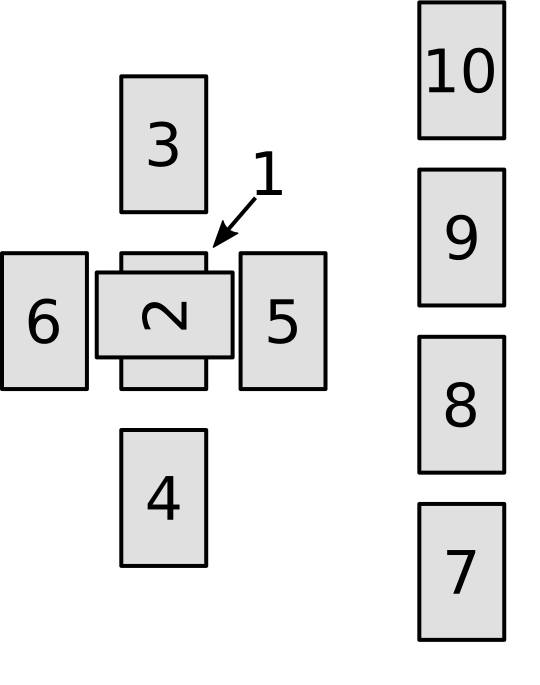
The two parts of the Celtic Cross: the central group and a separate column of positions. Compare the diagram with the description above.
Arthur Edward Waite · The Pictorial Key to the Tarot · public domainOpen sourceReading the Cross along axes
Do not read ten cards as ten separate news items. Look for axes: 'foundation → near future' is the vertical of time; 'person → environment' is the boundary of personal and external; 'hopes and fears → outcome' tests whether the person is enacting their own fear. Each axis turns two cards into one tension.
The card crossing the heart of the matter is the most important after the central one. Waite called it 'that which stands in the way.' Do not rush to call it bad: sometimes the crossing card is a resource the person treats as a problem, or a fear that is in fact a protection.
Year wheel and twelve houses
Twelve cards can be laid by months or by astrological houses. These are different schemes: months give chronology, houses give life domains. Do not mix them in one position. Add a central card for the overall theme and fix the cycle's start date in advance.
Reading is easier by quarters or groups of houses: identity and resources, communication and home, creativity and duties, relationships and shared resources, worldview and vocation, communities and the inner world. Look for repeated suits and transitions, not twelve disconnected predictions.
When a large spread is excessive
A large scheme is justified when the question is multi-layered: relocation, career change, annual planning, a tangled family situation. If the question fits in one sentence and concerns one decision, ten positions will create noise: you will start over-reading insignificant cards and lose the main one.
The test is simple: formulate the question and ask how many independent aspects it truly has. Two aspects — two or three cards. Five or more interrelated domains — the Cross or the year wheel makes sense. The number of cards should grow from the question's complexity, not from the desire to 'get more information.'
Exercises
- 1Draw the Celtic Cross and label each position's question in your own words.
- 2Do a decision spread for two options and add a list of three facts to verify without cards.
- 3Read the same question first with a triplet, then with the Cross. Write down what the seven extra positions genuinely added.
- 4Lay a year wheel by houses and find three groups of houses with repeated suits. Formulate each group's theme.