Tarot de Marseille
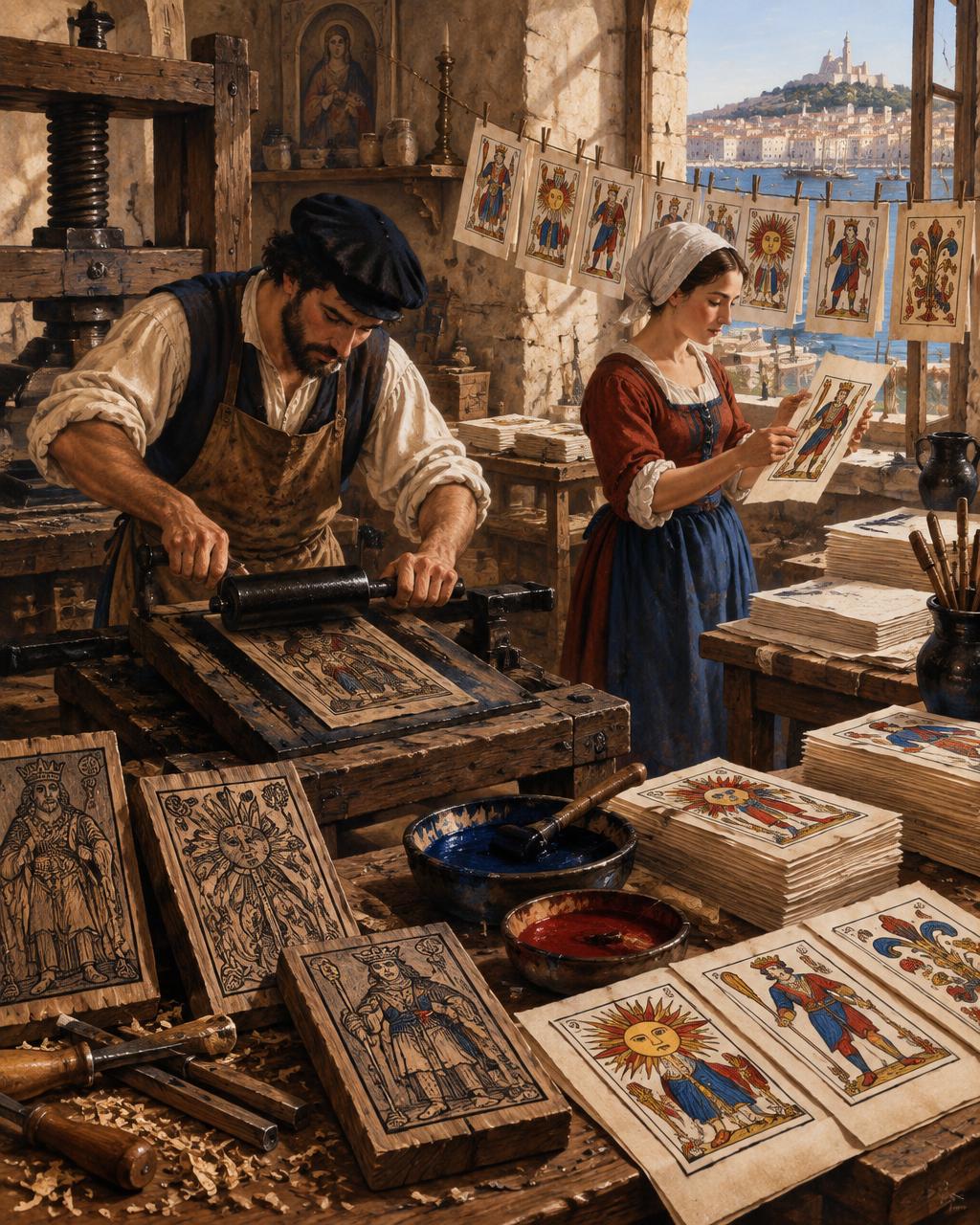
How a workshop pattern became a classical language
Key dates
Jean Noblet prints in Paris the earliest fully surviving deck of this type.
Jean Dodal prints a deck in Lyon, recording an intermediate stage of the compositions.
Nicolas Conver prints in Marseille a deck that became the later standard of the style.
Paul Marteau introduces and popularizes the term 'Tarot de Marseille' in his Grimaud deck edition.
Noblet, Dodal, Conver
The earliest fully surviving deck of this type is by the Parisian card maker Jean Noblet, dated to around the 1650s (the only known complete copy is held at the Bibliothèque nationale de France). It already shows compositions recognizable in the later 'Marseille' canon, though the drawing is coarser in places and differs in detail from later versions.
The deck of the Lyon card maker Jean Dodal (early eighteenth century, also held at the Bibliothèque nationale de France) and the deck of the Marseille printer Nicolas Conver (1760, now at the Bibliothèque nationale de France) reveal not one perfect original but a durable lineage of printed images, refined over more than a century of practice. It was Conver's deck, thanks to its later date and better-preserved example, that became the reference point for nineteenth- and twentieth-century reconstructions and the de facto standard of the 'Marseille' drawing.
Shared compositional features of this lineage are recognizable: the Bateleur stands at a table with small objects; the Popess (La Papesse) holds an open book; the Lover (L'Amoureux) is placed between two figures beneath a bow-wielding figure usually read as Cupid; the World (Le Monde) gathers around a nude dancing figure within an almond-shaped wreath, with symbols of the four evangelists in the corners.
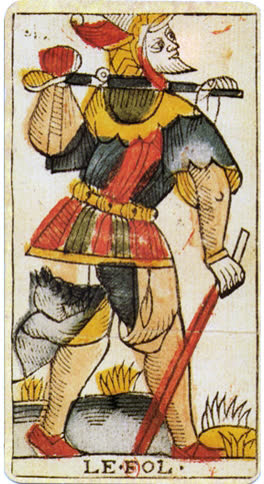
Jean Dodal's Fool, Lyon, 1701–1715: the unnumbered moving figure shows both the continuity of the Marseille language and the card's freedom from a fixed position.
Jean Dodal · Wikimedia Commons · public domainOpen sourceWhat the 'Marseille type' means
The term 'Marseille type' in modern card history (used, among others, by Thierry Depaulis and other specialists of the International Playing-Card Society) denotes not a single city of manufacture but a recognizable compositional scheme printed by workshops in Marseille, Lyon, Avignon, Toulouse, as well as Switzerland and Piedmont. Marseille became a metonym for the style partly because it was a major port hub for exporting cards across the Mediterranean, not the sole place of production.
Within this type there are notable local variants—for instance, differing spellings of card names (ITALIANO instead of FRANCIA appears in some Piedmontese printings), differences in figures' clothing details, and varying back-pattern ornaments—confirming a picture of many workshops operating within a shared tradition rather than copying one template under a single center's control.
It matters for historians to separate the 'Marseille type' as a descriptive category coined by twentieth-century art historians from the living seventeenth- and eighteenth-century practice, in which makers simply continued and slightly modified inherited compositions, without formulating for themselves any doctrine of a 'classical' or 'true' Tarot.
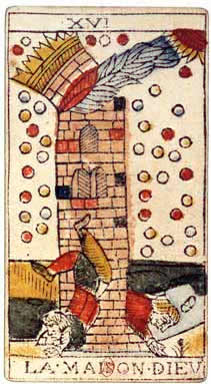
Jean Dodal's La Maison Dieu lets us compare the later psychological reading of crisis with an early-eighteenth-century workshop composition.
Jean Dodal · Wikimedia Commons · public domainOpen sourceArchetypes before psychology
Today these figures are easily called archetypes, yet historically they grew from a shared repertoire of sermons, religious festivals, carnival processions, morality plays, and popular printed imagery of their time—the same visual language that fed broadsheets, emblem books, and parish altar paintings.
A modern reading may see in the Tower (La Maison Dieu) an image of sudden crisis and shattered illusion, and in the Hermit an archetype of inner searching and wise old age; a seventeenth-century craftsman carving a printing block for a guild or merchant's commission need not have intended those particular psychological meanings—his task was to reproduce a recognizable, sellable composition.
This does not diminish the value of later readings, but it is historically accurate to separate two things: the stability of the visual form, settled through seventeenth- and eighteenth-century craft printing practice, and the mobility of meanings that different eras—from the Enlightenment to twentieth-century psychology—read into that form anew, not discovering it but creating it.
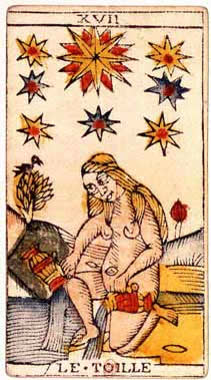
Dodal's Star shows how gesture, water, and celestial signs moved between workshops long before modern meaning guides.
Jean Dodal · Wikimedia Commons · public domainOpen source