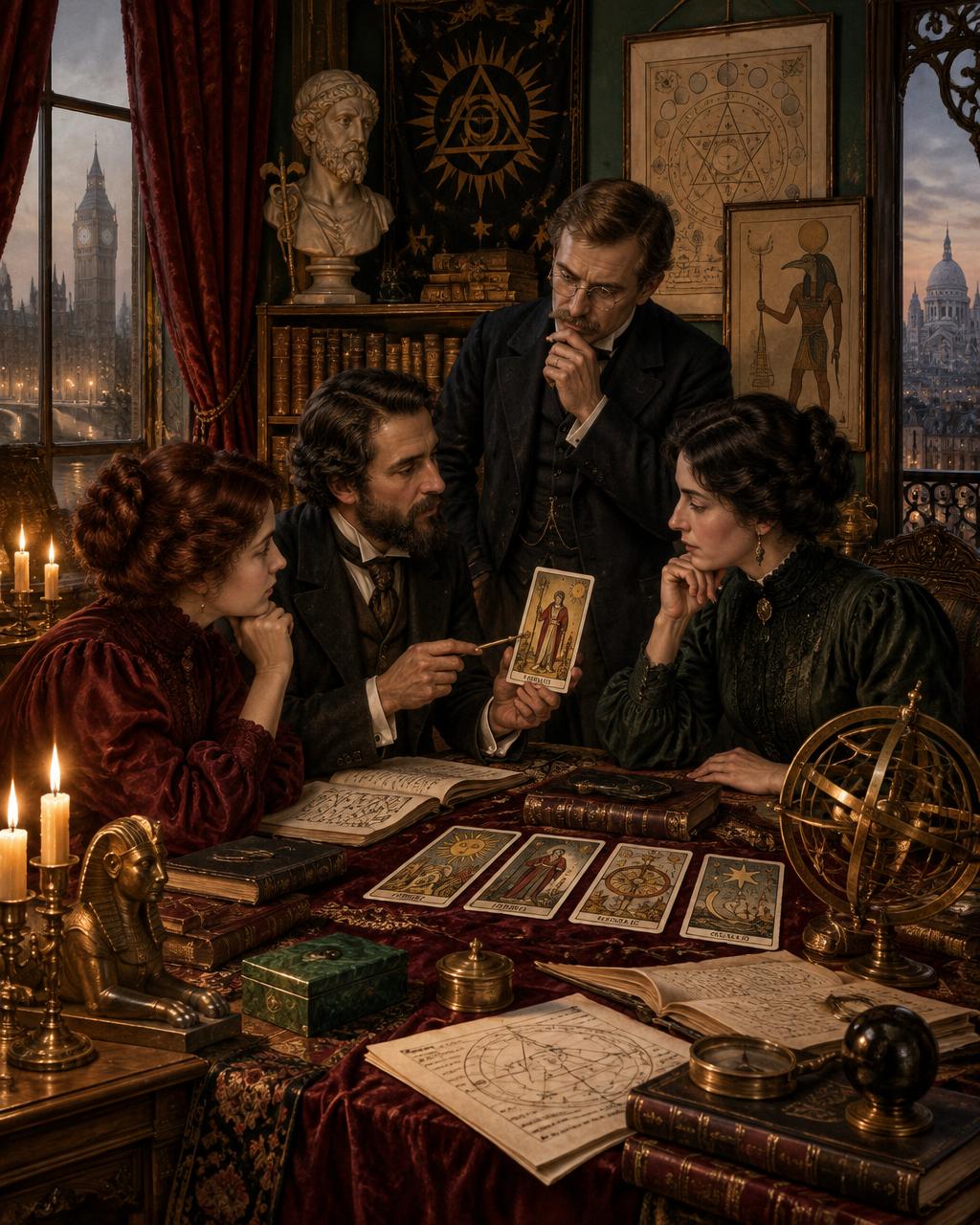
The Egyptian myth and divinatory Tarot
Court de Gébelin, Etteilla, and the great turn
Key dates
Etteilla (Jean-Baptiste Alliette) begins publishing manuals on fortune-telling with ordinary playing cards.
Court de Gébelin publishes volume eight of Monde primitif with an essay naming Tarot the “Book of Thoth”; the Comte de Mellet introduces the Hebrew-letter correspondence.
Etteilla publishes a treatise adopting and elaborating the Egyptian hypothesis.
Etteilla issues the first deck designed specifically for occult divination.
Champollion deciphers Egyptian hieroglyphs, finding no support for the Egyptian theory of Tarot.
Court de Gébelin and a salon encyclopedia
Antoine Court de Gébelin (1719–1784) was a Protestant pastor, Freemason, and author of the nine-volume Monde primitif (“Primitive World”), which attempted to reconstruct a single common source for human languages, myths, and customs. His interest in Tarot was reportedly accidental: by his own account he saw a pack at a Parisian social gathering around 1780 and was struck by what he took to be an obviously Egyptian character in the imagery—despite never having visited Egypt or read an Egyptian text, since hieroglyphic script could not yet be read.
In the eighth volume of Monde primitif (1781), Court de Gébelin devoted an essay to Tarot, declaring the deck a surviving “Book of Thoth”—a compendium of ancient Egyptian wisdom supposedly rescued by priests and secretly carried across centuries by the Roma (the root of the persistent but historically unsupported legend of a Romani origin for fortune-telling cards). In the same volume, his collaborator the Comte de Mellet (Louis-Raphaël-Lucrèce de Fayolle) first linked the twenty-two trumps to the twenty-two letters of the Hebrew alphabet—an idea with no basis in any fifteenth- to seventeenth-century Italian or French pack, yet one that would prove remarkably durable.
Modern historiography (Dummett, Decker, Depaulis, Volokhine) treats Court de Gébelin's claim as a characteristic product of the Enlightenment's vogue for Egypt, fed by early travelers' accounts and a fashion for Egyptianizing decor rather than genuine knowledge of hieroglyphs. No documentary link exists between fifteenth-century Italian triumph cards and Egyptian priestly practice, and the word “Tarot” has no demonstrated Egyptian etymology, contrary to Court de Gébelin's assumption.
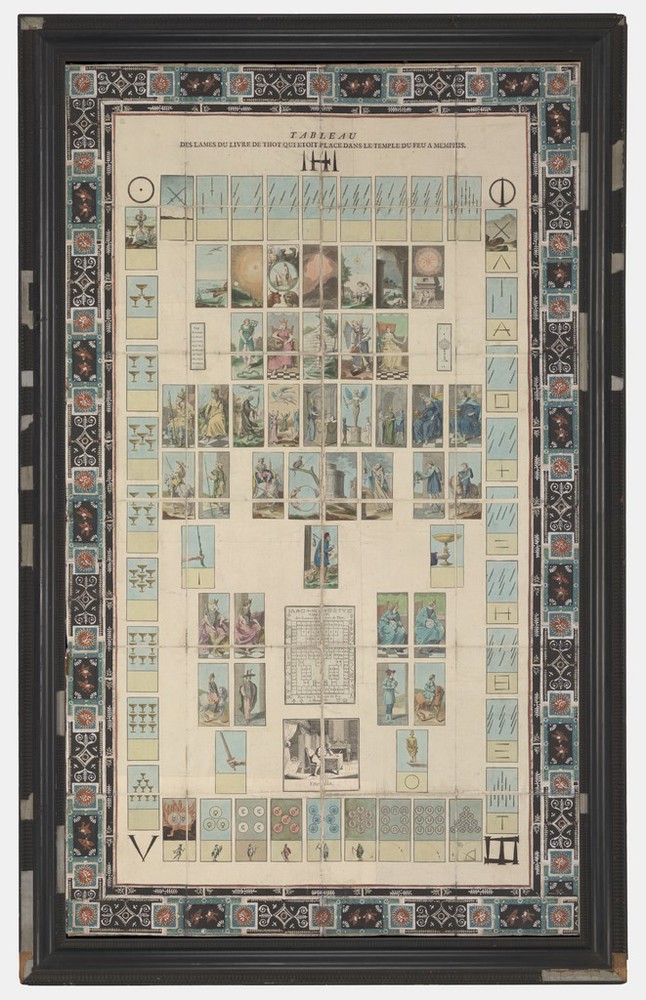
This teaching tableau turns card reading into an ordered system: groups, directions, and correspondences could be studied like a map.
Wellcome Collection · Public Domain MarkOpen sourceEtteilla: from street diviner to system
Jean-Baptiste Alliette (1738–1791), a Parisian seed and grain merchant, had already been practicing card divination and publishing manuals under his name reversed as an anagram—Etteilla—since the 1770s, writing about cards even before reading Court de Gébelin, but he quickly adopted the Egyptian hypothesis and elaborated it far further. In his 1780s treatises (including Manner of Entertaining Oneself with a Pack of Cards Called Tarot, 1785), he claimed the Book of Thoth had been composed in an Egyptian temple by seventeen magi 171 years after the Flood—a chronology unconnected to any real history of writing or to Tarot's actual date.
Around 1788–1789 Etteilla issued his own deck, entirely redrawn to fit his system, with new titles, numbering, elemental divisions, and detailed upright and reversed meanings for divination. This was the first time in Tarot's history that a deck was designed from scratch purely for esoteric reading rather than reinterpreting an existing game pack. Etteilla is also credited with popularizing the now-widespread practice of assigning distinct meanings to reversed cards.
Etteilla founded several short-lived societies (including a “Society of Interpreters of the Book of Thoth”) and students who carried his method forward into the nineteenth century, even though he died in 1791 in relative poverty. Historians emphasize that Etteilla, not Court de Gébelin, began the continuous practical tradition of Tarot divination: Court de Gébelin supplied a myth, Etteilla supplied a method.
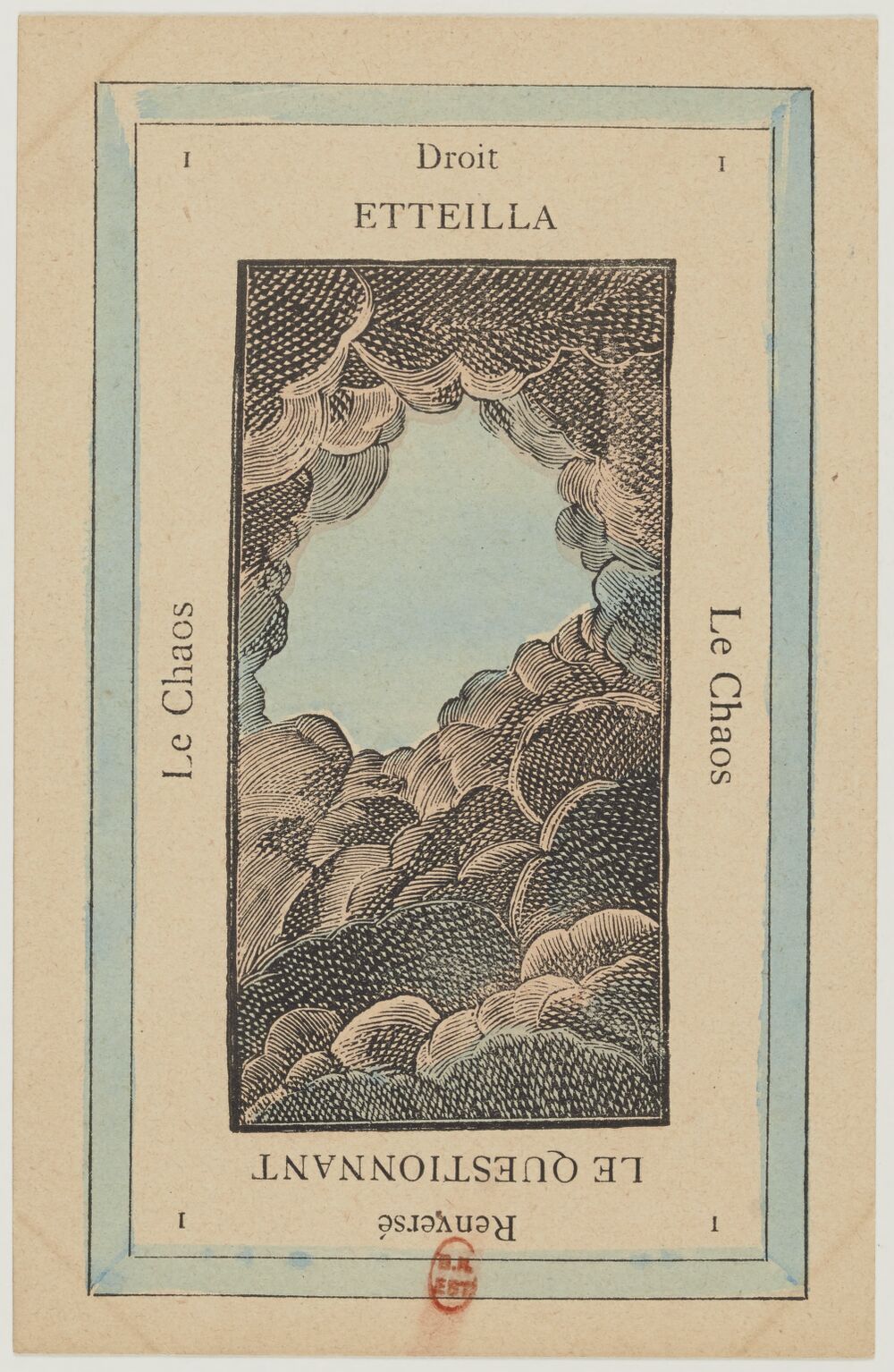
Card I, 'Chaos,' from Etteilla's system. Upright and reversed positions are printed on the card itself, making interpretation part of the deck's design.
Bibliothèque nationale de France, Gallica · public domainOpen sourceWhy the myth outlived its refutations
In 1822 Jean-François Champollion presented the principles for decoding hieroglyphs, and a century of subsequent Egyptology found no text confirming the Book of Thoth as a card deck. Even so, the Egyptian legend did not disappear; it was taken up by the next generation of occultists—chiefly Éliphas Lévi, and then the Hermetic Order of the Golden Dawn—who fused it with Kabbalah and astrology (see the next chapter). The myth proved useful: it lent the deck the authority of deep antiquity and justified freely layering on new symbolic systems.
Modern card historians—above all Michael Dummett, Ronald Decker, and Thierry Depaulis in their trilogy on the “esoteric Tarot”—have consistently shown that no source before 1781 connects Tarot with Egypt, divination, or secret knowledge: through the late eighteenth century it remained simply a European card game. Acknowledging this does not diminish the cultural value of the occult tradition, but it separates historical reconstruction from later, creative reinvention.
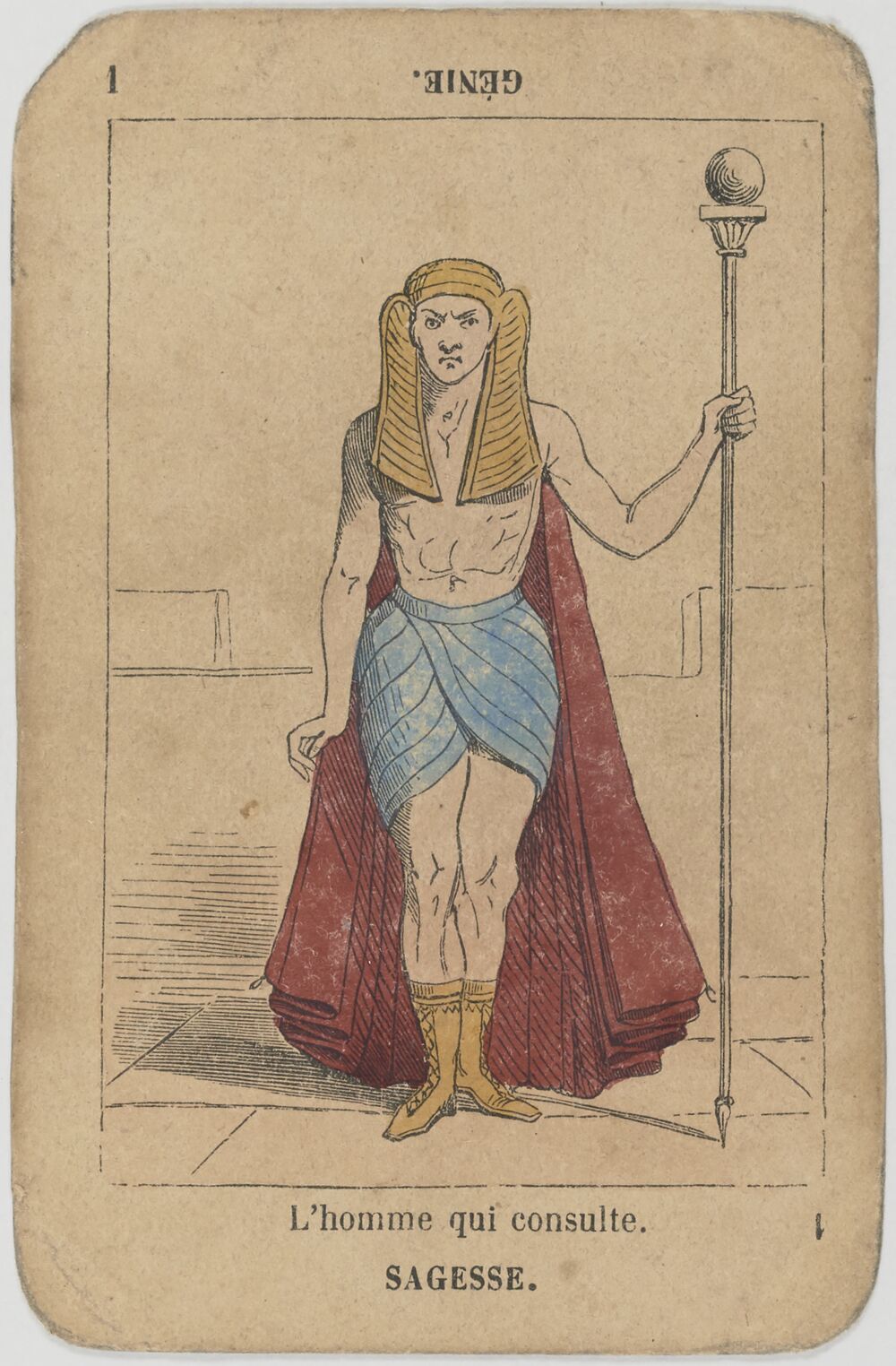
'Wisdom': a later French divination card shows how Egyptianizing imagery continued after Etteilla.
Bibliothèque nationale de France, Gallica · public domainOpen sourcePeople, places, and decks
Sources and further reading
- 1. Ronald Decker, Thierry Depaulis & Michael Dummett, A Wicked Pack of Cards: The Origins of the Occult Tarot (1996)
- 2. Y. Volokhine, The Egyptian Tarot: The Story of a Counterfeit
- 3. Thierry Depaulis, Tarot, jeu et magie (1984)