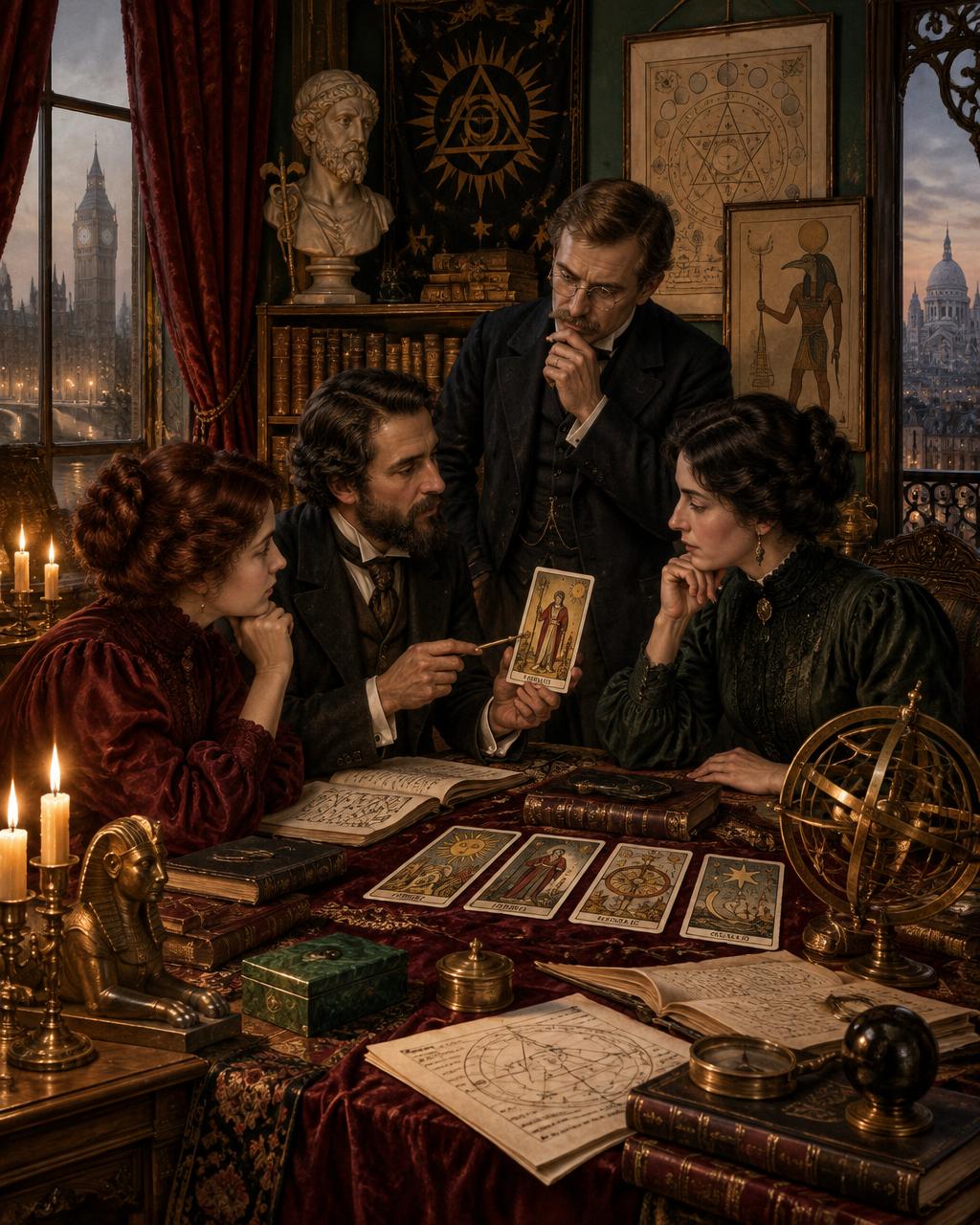
The occult synthesis
Éliphas Lévi, Kabbalah, and the Hermetic order
Key dates
Éliphas Lévi publishes Dogme et rituel de la haute magie, establishing the trump–Kabbalah link.
The Hermetic Order of the Golden Dawn is founded in London (Westcott, Mathers, Woodman).
Mathers compiles the order's internal Tarot teaching materials ('Book T').
A series of internal schisms, involving Crowley; offshoot organizations emerge.
Éliphas Lévi joins traditions
Alphonse Louis Constant (1810–1875), a former seminarian who wrote as Éliphas Lévi, built an influential synthetic system in Dogme et rituel de la haute magie (1854–1856) and Histoire de la magie (1860), matching the twenty-two Tarot trumps to the twenty-two Hebrew letters, the Kabbalistic Tree of Life, and categories of ceremonial magic. Lévi drew on the earlier ideas of de Mellet and Etteilla but gave them a far more systematic and philosophically ambitious form, presenting Tarot as a universal 'hieroglyphic alphabet' of thought.
Lévi himself was not a practicing cartomancer in Etteilla's mode; his interest lay chiefly in a symbolic metaphysics uniting disparate esoteric traditions—Kabbalah, Gnosticism, alchemy, and ritual magic—into what he called a single 'secret science.' Historians of occultism (Christopher McIntosh, among others) note that Lévi's system is a characteristic nineteenth-century syncretic project reconstructing a 'lost tradition,' rather than the transmission of any verifiably ancient teaching.
Lévi never left a fully consistent card-by-card attribution—his own texts on card order and correspondences are at points contradictory. It was later generations, chiefly members of the Hermetic Order of the Golden Dawn, who systematized and completed his ideas into a finished table of correspondences.
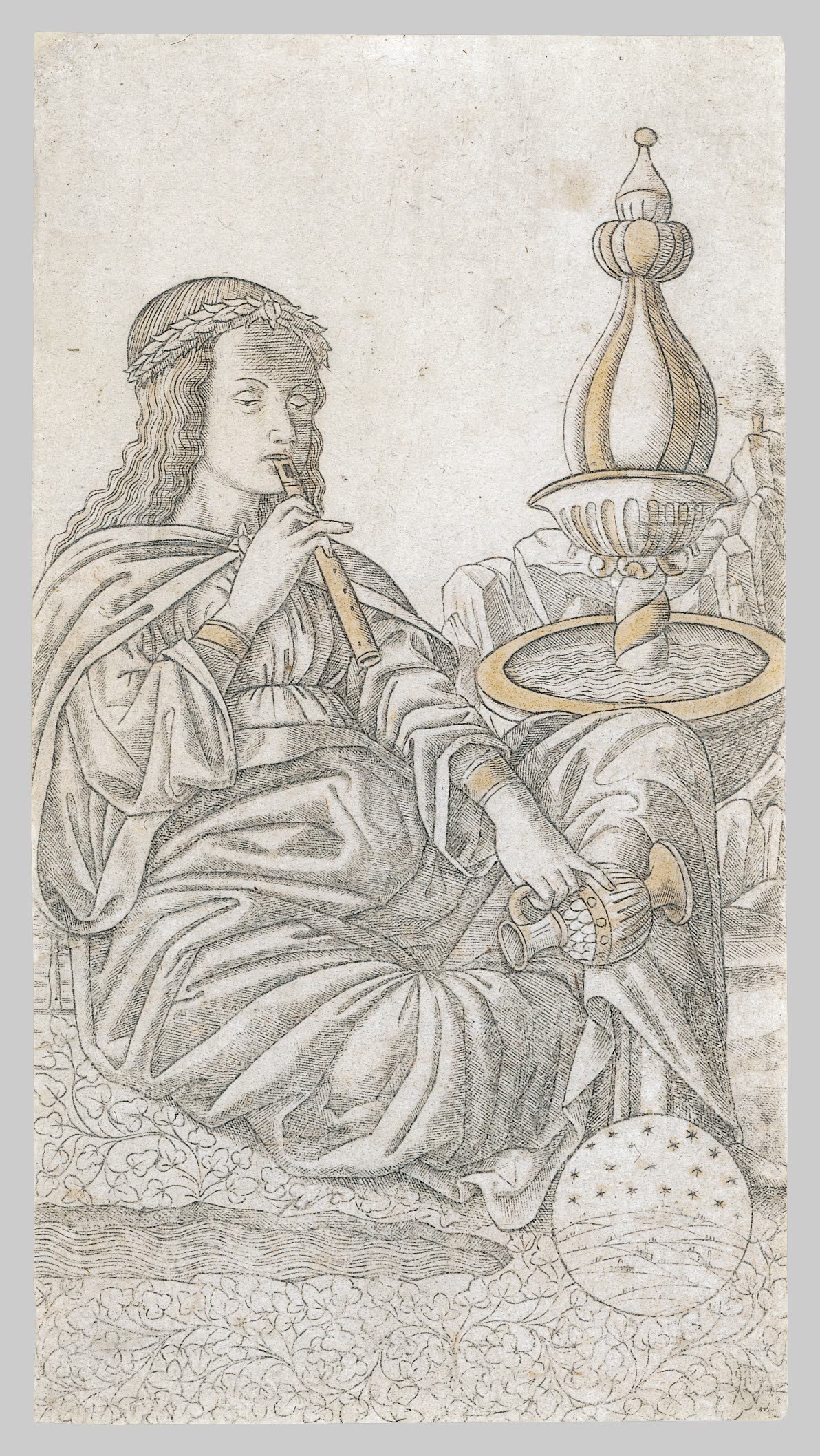
Poetry, Ferrara, c. 1465–1467. This educational engraving was not a Tarot card; its former misidentification shows how easily later catalogues conflated similar image series.
The Metropolitan Museum of Art · public domainOpen sourceThe Golden Dawn: institution and method
The Hermetic Order of the Golden Dawn was founded in London in 1888 by William Wynn Westcott, Samuel Liddell MacGregor Mathers, and William Robert Woodman—three Freemasons drawn to Rosicrucian and Kabbalistic symbolism. The order developed a dense and highly detailed system of 'correspondences': zodiac signs, planets, the four elements, the ten sefirot and twenty-two 'paths' of the Tree of Life, colors, incenses, deities from various pantheons, and ritual grades of initiation—all organized into unified tables, a kind of 'periodic table' of Western esotericism.
Within this system the Tarot trumps were assigned to paths on the Tree of Life, and the deck itself was renamed: the now-familiar terms 'Major Arcana' and 'Minor Arcana' were fixed in Golden Dawn and post-Golden-Dawn literature, replacing the earlier 'trumps' and 'suit cards.' The order also renamed some cards and swapped the positions of Strength and Justice relative to the classic Marseille sequence, to fit the deck to its astrological and alphabetic logic.
Members at various times included the poet W. B. Yeats, the actress Florence Farr, the writer Moina Mathers, and later Arthur Edward Waite and Aleister Crowley—both of whom emerged from the order (or its later splinter branches) to create the decks that would define twentieth-century Tarot. It is worth stressing that the order's internal documents were closed teaching materials (the order's 'Book T' Tarot instructions, compiled by Mathers around 1888), and only later were their contents retold by students in public form.
Schisms and legacy
Between 1900 and 1903 the order went through a series of schisms sparked by personal conflicts (including disputes around Aleister Crowley and access to the higher grades), giving rise to offshoot organizations such as Alpha et Omega and Stella Matutina. It was from this fragmented legacy that Waite and Crowley independently took up the correspondence system as a foundation for their own, differing treatments of Tarot, discussed in the next chapter.
Historically, it is important not to confuse the antiquity of individual symbols (many of which—elemental images or planetary signs, for example—derive from medieval and Renaissance astrology and alchemy) with the antiquity of the system mapping them onto Tarot: that mapping took shape only in the mid-to-late nineteenth century and is the product of identifiable authors, not 'recovered' ancient knowledge.
People, places, and decks
Sources and further reading
- 1. Ronald Decker, Thierry Depaulis & Michael Dummett, A Wicked Pack of Cards (1996)
- 2. R. A. Gilbert, The Golden Dawn: Twilight of the Magicians (1983)
- 3. Mary K. Greer, Women of the Golden Dawn (1995)