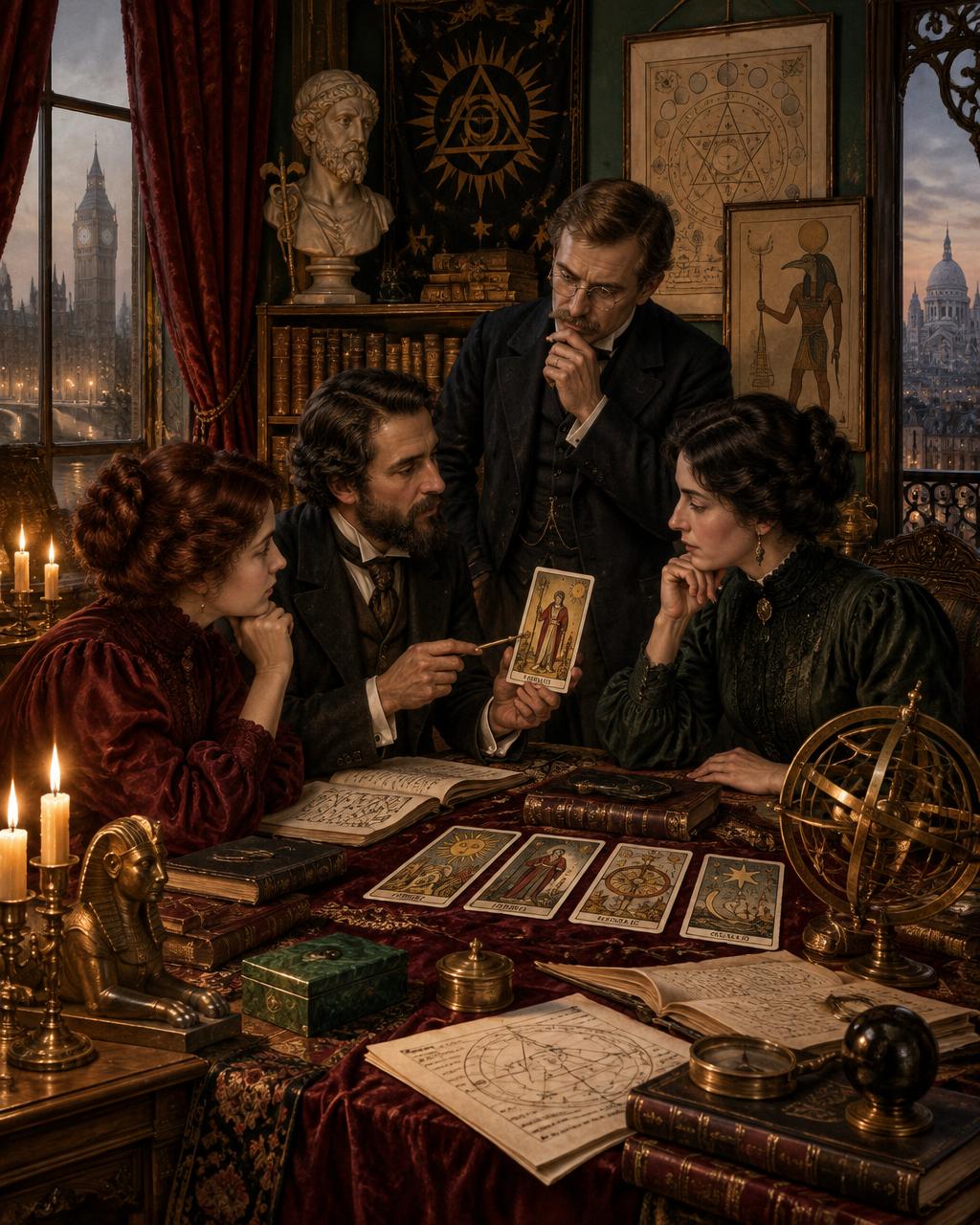
Two decks that changed the twentieth century
Pamela Colman Smith, Waite, Frieda Harris, and Crowley
Key dates
William Rider & Son publishes the Waite–Smith deck in London.
Waite publishes The Pictorial Key to the Tarot.
Frieda Harris paints the Thoth deck to Crowley's program.
The Thoth deck is first fully published (posthumously for both creators).
U.S. Games Systems acquires RWS rights and begins mass reprinting.
Waite, Smith, and the Rider imprint
Arthur Edward Waite (1857–1942), American-born, a member and later a leader of a splinter branch of the Golden Dawn, envisioned a deck that would give a beginning reader clearer narrative footing than the more abstract order schemes. To execute it he engaged Pamela Colman Smith (1878–1951), a Jamaican-British artist and illustrator connected to the order and active in London's theatrical and publishing circles (she illustrated books by W. B. Yeats and worked with Ellen Terry's theater).
The deck was published in December 1909 by the London house William Rider & Son, the source of the later part of the traditional name 'Rider.' Smith's contract was a flat one-time fee with no royalties, and during her lifetime her name was routinely omitted or subordinated to Waite's. Only in the second half of the twentieth century did historians and collectors (notably Mary K. Greer and Stuart Kaplan in his Encyclopedia of Tarot volumes) secure fuller recognition of her authorship, cementing the compound name 'Rider–Waite–Smith' (RWS) now standard in academic and museum practice.
Smith's decisive artistic contribution was fully illustrated narrative scenes on the numbered Minor Arcana—previously depicted almost everywhere as a mere geometric array of suit symbols (for example, six swords on a card with no figures). This innovation radically eased intuitive, associative reading and has since become the norm for most modern authored decks.
Waite's doctrine and companion book
Waite accompanied the deck with a guidebook, The Pictorial Key to the Tarot (1910), in which he deliberately gave incomplete meanings, reserving part of the 'secret doctrine' for initiated members of his own order (the Fellowship of the Rosy Cross)—a device typical of occult literature of the period. He also renamed several cards (adopting the Golden-Dawn-style reordering of Strength and Justice) and replaced 'Pope' and 'Popess' with the more neutral 'Hierophant' and 'High Priestess' to reduce direct allusions to Catholic hierarchy.
Despite its pretensions to hidden depth, it was precisely the openness and clarity of the RWS imagery that made the deck the most widely reproduced in the world: by publisher estimates (U.S. Games Systems, which has held the rights since 1971), it had sold tens of millions of copies by the twenty-first century and underlies the great majority of modern English-language Tarot instruction books.
Harris, Crowley, and the geometry of Thoth
Aleister Crowley (1875–1947), a former Golden Dawn member and founder of his own religious-philosophical movement, Thelema, conceived the Thoth deck as a visual statement of his cosmology, uniting Egyptian symbolism, Kabbalah, astrology, and the poetics of his own Book of the Law (1904). To execute the project he engaged the artist Lady Frieda Harris (1877–1962), the wife of a Member of Parliament, who worked professionally in modernist painting and was fascinated by projective geometry.
Work on the deck ran from 1938 to 1943 (far longer than the few months originally planned) and proceeded through correspondence: Crowley formulated the symbolic program for each card while Harris translated it visually, frequently disputing with him and insisting on her own artistic choices. The resulting seventy-eight cards feature complex, layered compositions, saturated modernist color, and a deliberate rejection of linear perspective in favor of symbolic geometry.
Crowley renamed several trumps in line with Thelemic philosophy (Strength became Lust, Justice became Adjustment, and Judgement became The Aeon), and replaced the Jack and Page with Princesses and Knights in an expanded court hierarchy. The deck was first fully published only in 1969, after both creators had died, by U.S. Games Systems, and has gained a reputation as one of the most artistically ambitious and philosophically dense decks of the twentieth century—while remaining an authored, recognizably Crowleyan system rather than a 'more authentic' version of an ancient Tarot.
People, places, and decks
Sources and further reading
- 1. Stuart R. Kaplan, The Encyclopedia of Tarot, vols. I–IV
- 2. Mary K. Greer, Pamela Colman Smith: The Untold Story (2018, with Elizabeth Foley O'Connor)
- 3. Lon Milo DuQuette, Understanding Aleister Crowley's Thoth Tarot (2003)