Anatomy of the deck
How 78 cards form a system rather than a list of meanings
The three layers of the deck
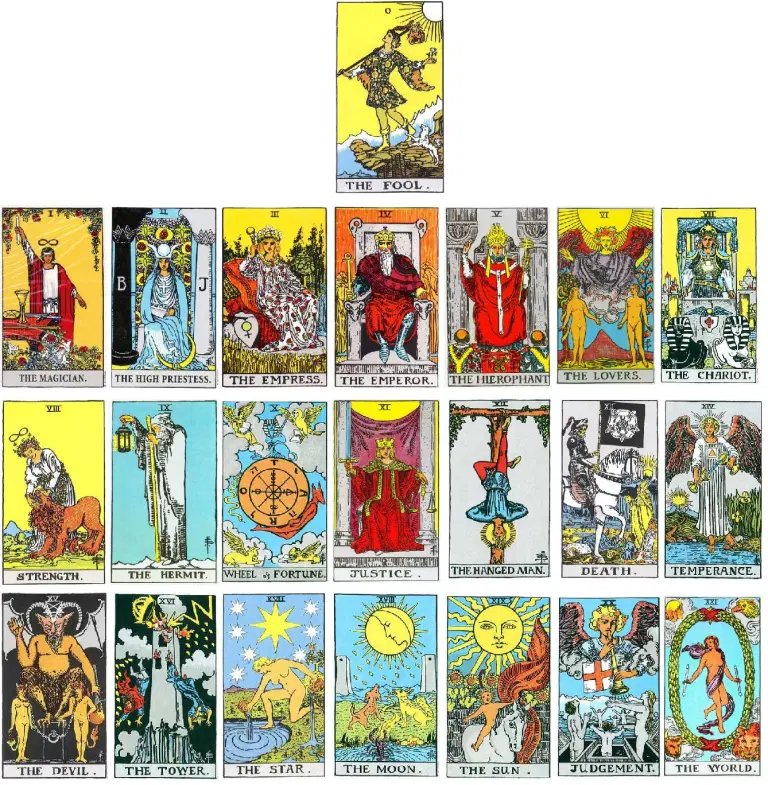
The Major Arcana are 22 images of large life themes: the beginning of a journey (The Fool), will and skill (The Magician), inner knowledge (The High Priestess), crisis (The Tower), completion and integration (The World). In a spread they usually signal that the situation touches a deep layer — values, a life stage, a significant lesson — rather than only today's practical task.
The forty pip cards (ace through ten in four suits) describe ongoing processes: work, relationships, money, decisions, fatigue, growth. They are the weather of everyday life. The sixteen court cards — Page, Knight, Queen, and King of each suit — most often read as people, roles, or styles of action: the student, the seeker, the keeper, the leader.
The practical takeaway: before recalling a card's meaning, identify its layer. A Major in the advice position speaks of changing your attitude toward the situation; a pip card in the same position points to a concrete action; a court card indicates who — or what manner of behaviour — will help. This alone makes a reading noticeably more precise.
The numerical logic of the Minor Arcana
Numbers in Tarot are not decoration but a skeleton. Aces are the seed and potential, the pure energy of a suit before it manifests. Twos are choice, balance, first interaction. Threes are first growth and a visible result. Fours are stability, sometimes stagnation. Fives are trial and loss of balance. Sixes are recovery, exchange, movement after crisis.
Sevens are assessment, strategy, a test of strength. Eights are work, acceleration, honing a skill. Nines are the nearly completed cycle, accumulated experience, sometimes defended boundaries. Tens are completion and fullness: the cycle is closed, and its outcome is either a resource or a burden it is time to set down.
Learn this axis once and you gain forty meanings almost for free: simply combine number with suit. The Five of Cups is a crisis in the realm of feeling, grief over a loss. The Five of Pentacles is the same crisis in the material realm: money, work, health, shelter. One logic, different domains.
Suits and elements
Wands are linked to fire: initiative, desire, energy, projects, forward motion. Cups to water: feelings, relationships, intuition, dreams. Swords to air: thought, speech, conflict, decision, truth. Pentacles (coins) to earth: body, money, work, home, material results.
The suit answers the question 'in which domain is this happening?' If a work reading is full of Cups, the situation resolves through relationships and emotional climate rather than paperwork. Many Swords in a feelings question signals that the person is living the situation in their head — analysing instead of feeling.
A suit exercise brings fast growth: take all cards of one suit, lay them ace to ten, and follow the storyline. For Wands it is the story of an intention from spark to the heavy burden of the ten. For Cups, the story of a feeling from first gift to the full cup. The suit is then remembered as a coherent drama, not a set of flashcards.
Court cards: people, roles, stages
The most common beginner question: is a court card a person or a quality? The working answer: check the position first. In a 'who influences' position it is almost always a person or their role. In an 'advice' position it is a manner of action. In a 'what is inside me' position it is a part of the personality the situation asks to switch on.
The court ranks read as stages of maturity. The Page is the student, the message, first contact with the suit's energy. The Knight is movement, extremity, pursuit: already acting, not yet balanced. The Queen is mature inner mastery, acceptance and cultivation. The King is mature outer mastery: governance, responsibility, structure.
It helps to keep each figure's shadow in mind: the Page can be immaturity, the Knight obsession, the Queen dissolution into others, the King control. The shadow does not cancel the resource: it shows what a quality becomes when there is too much of it or when it works against the person rather than for them.
How to choose your first deck
For learning, three things matter: scenic Minor Arcana (so there is something to look at), available literature, and a personal response to the artwork. That is why a deck based on the Rider–Waite–Smith system is most often recommended: each of the 78 cards is a scene you can read, not a decorative sign, and the literature on the system is vast.
The Marseille tradition leaves the pip cards without scenes and teaches you to read rhythm, number, suit, and ornament — an excellent school of observation, but usually a second deck rather than a first. The Thoth Tarot builds a dense web of astrological and kabbalistic correspondences and requires readiness for systematic study.
A simple in-store test: open images of three cards — The Tower, the Nine of Swords, and the Ten of Cups. If each triggers an instant bodily reaction and a first phrase ('this is collapse', 'this is insomnia', 'this is a warm home'), the deck speaks to you. If the pictures are pretty but silent, put it back — even if it is fashionable.
Exercises
- 1Split the deck into three groups: Majors, pips, and court cards. Without a reference book, write one sentence about the function of each group.
- 2Pick one number from 2 to 10 and compare it across all four suits. Find the shared process and its four different expressions.
- 3Lay out one suit from ace to ten and retell it as a story in ten sentences.
- 4List all Pages, Knights, Queens, and Kings and give each a modern nickname: intern, perfectionist, mentor, director.