Reading the image
Observation before memorized meaning
The method: describe, connect, interpret
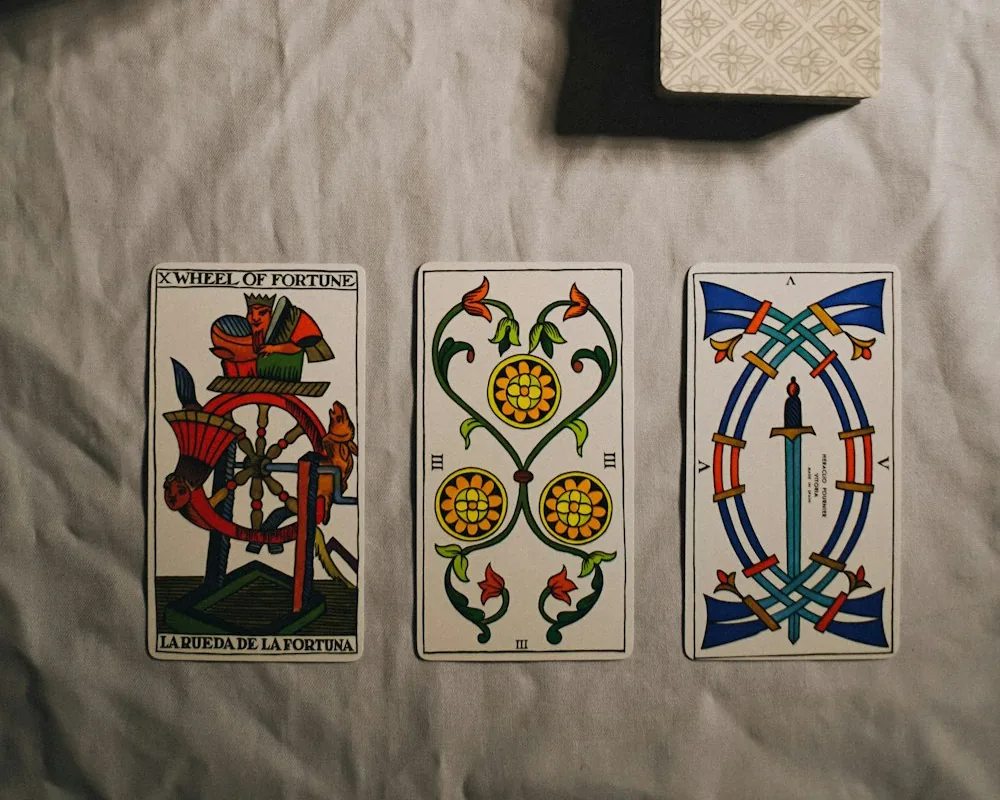
Reliable reading is built in three steps. First, pure description without interpretation: 'a woman sits on a throne, behind her a curtain with pomegranates, the moon at her feet.' Then, connection to the question: 'the question is about feelings, and the figure is calm and closed.' Only then, meaning: 'the feeling exists, but it is not yet named or shown.'
This order protects against two extremes: mechanically reciting the reference book and free-floating fantasy. If a conclusion cannot be tied to a visible detail or to the position, it is not yet proven. If the description never reaches the person's question, the reading remains beautiful but useless.
Train each step separately. One day, describe cards without a single evaluative word. Another day, take a finished description and find three different connections to three different questions. On the third, formulate a meaning in one sentence that cannot be moved to another card without losing precision.
Colour, gesture, direction of gaze
In a good deck nothing is drawn by accident. The direction of a figure's gaze shows where the card's energy points: left — often to the past or inward, right — to the future or outward, straight at the viewer — the theme demands direct contact. In a spread, figures' gazes toward neighbouring cards create 'lines of conversation' between positions.
Gesture reads literally: open palms — acceptance or giving, crossed arms — defence, an outstretched hand — an offer or a request. Colour sets the emotional background: red — action and passion, blue — thought and distance, yellow — mind and joy, grey — fatigue and fog. The landscape sets the scale: desert, garden, city wall, and stormy sea describe different conditions of the same process.
Do not turn this into a table of 'red = love.' A detail works only inside a specific card and a specific question. The red robe of The Lovers and the red robe of The Emperor are different reds: in one, passion and choice; in the other, power and readiness to act.
A personal vocabulary without invention
A personal association is useful if you can explain which element of the card triggered it and how it answers the question. The note 'the red cloak reminds me of determination because the figure walks against the wind' is verifiable; the note 'the card promises a phone call on Tuesday' rests on neither image nor position.
Keep two columns: 'what I see' and 'what it might mean.' After a month, highlight the recurring observations. This is how a personal language emerges — one that neither cancels the deck's history nor turns any impression into prophecy.
A useful filter is the question 'could I explain this conclusion to another person while pointing at the card?' If yes, the association works. If the explanation requires the phrase 'I just feel it,' return to the image and find what exactly you feel — the gaze, the gesture, the empty background, the tilted composition.
Working with an unfamiliar deck
A new deck is a new artistic translation of a familiar system. Start by leafing through the whole deck without reading: note the cards that attract you and the ones that repel. Both are your future teachers: attraction shows what already resonates, repulsion shows where the blind spot is.
Then take the five cards that differ most from the version you know and analyse what the artist changed: plot, angle, mood, symbols. A change is always an emphasis: the deck's author is telling you what they consider essential in this meaning.
Give a new deck a trial period — for example, two weeks of daily one-card pulls before reading with it for others. In that time you learn its voice: some decks speak softly and imagistically, others drily and precisely, others through humour. The reader adapts to the voice rather than breaking it to fit themselves.
Exercises
- 1Take an unfamiliar card. Write down 12 observable details, 6 verbs, and only then 3 possible meanings.
- 2Compare one card in two decks. Note which meaning both versions support and which one the specific artist creates.
- 3Trace the gazes of all figures in a three-card spread: who looks at whom, who turns away. Note how this changes the connection between positions.
- 4Describe a card so that someone who cannot see it could sketch it roughly. Check which details you missed.