The birth of the triumphs
Ferrara, Milan, Bologna, and the courtly packs of the Renaissance
Key dates
The earliest payment records for trionfi cards at the Ferrara and Milan courts.
Creation of the hand-painted cards later known as the Visconti-Sforza deck.
Francesco Sforza becomes Duke of Milan; courtly commissions of packs continue at his court.
First reliable written use of the word tarocchi in a Ferrara document.
The manuscript Discorso del Pratesi records the rules of the tarocchi game.
The earliest written evidence
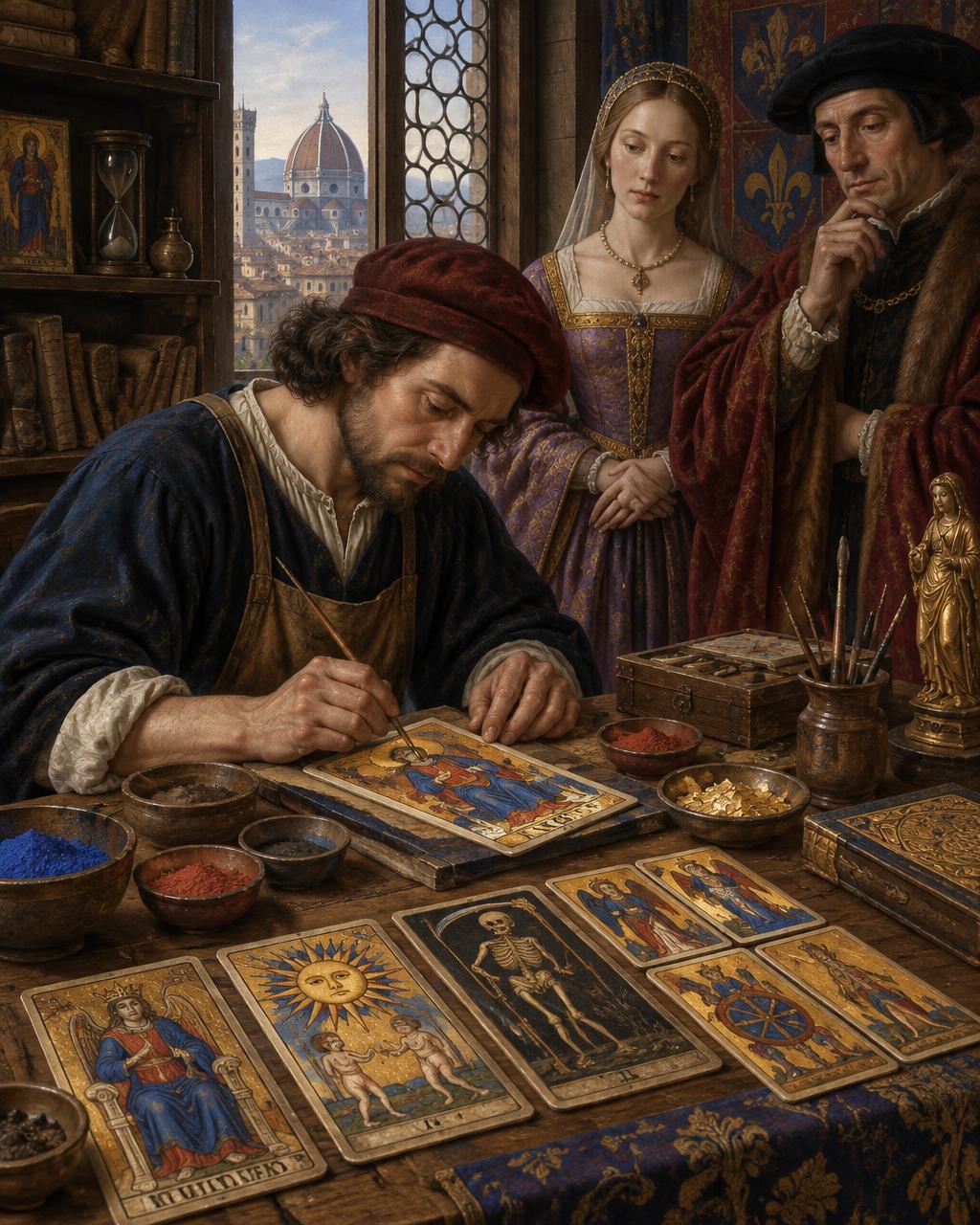
The earliest known reference to trionfi cards is a 1442 payment record for a painter at the Ferrara court; similar references appear in Milan and Florence through the 1440s. These documents—invoices, inventories, letters—are far more reliable than later legends, because they record dates, sums, and craftsmen's names without any mystical framing.
The game itself, as reconstructed from sixteenth-century treatises (such as the manuscript Discorso del Pratesi, c. 1565) and later Italian sources, was a trick-taking game for several players in which the added triumphs outranked the ordinary suits, much as trumps work in modern bridge or whist. This explains the Italian name of the game—trionfi, from Renaissance triumphal processions and pageant floats—rather than any reference to Tarot cards as such.
The name tarocchi (and its derivatives in French, German, and English—tarot, Tarock, tarot) was fixed later: the earliest reliable written use is dated 1505 (a payment record at the Ferrara court). Before that, the pack and game were simply called trionfi, which occasionally causes confusion in earlier literature.
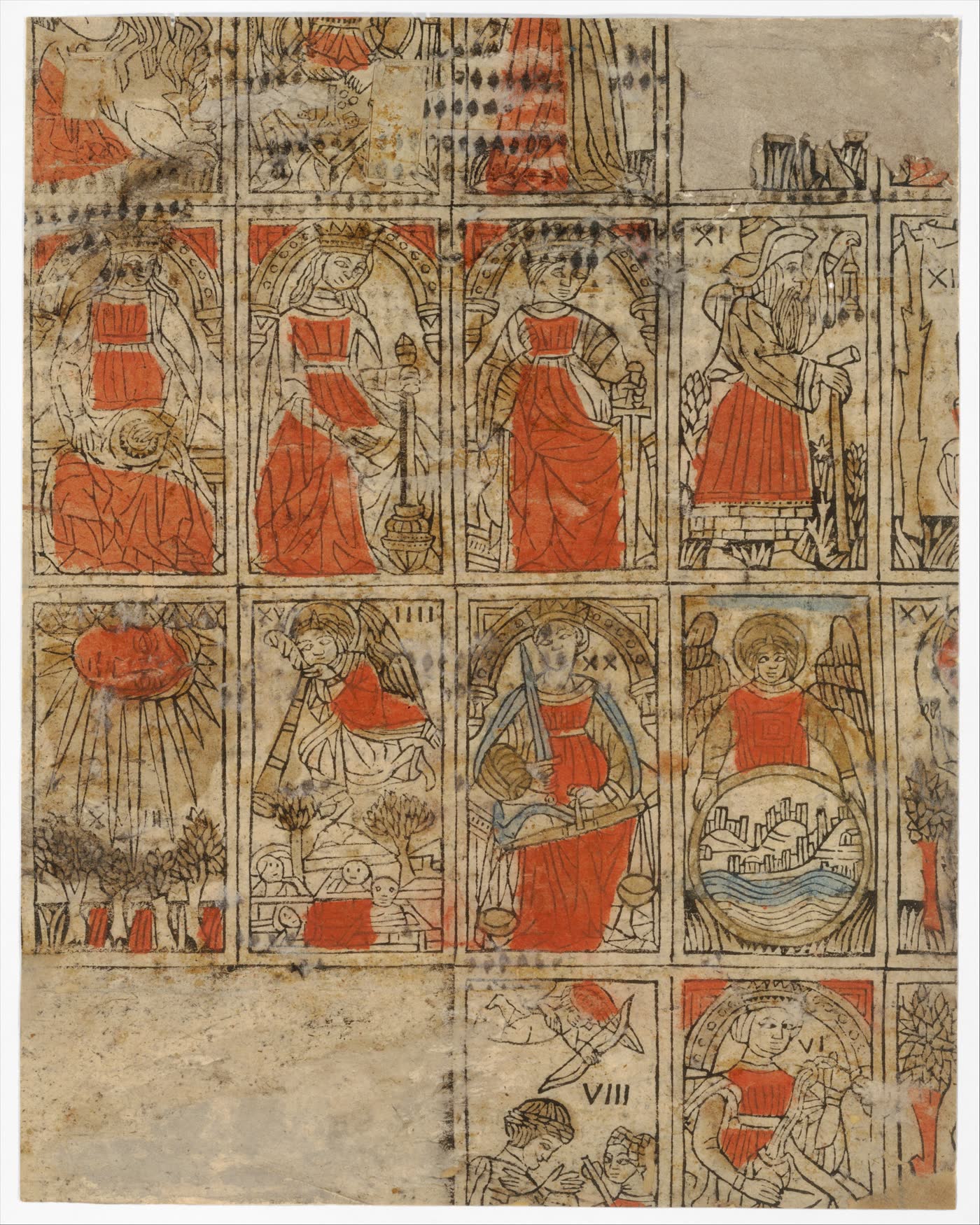
This sheet of tarocchi cards shows how several images were printed together before being cut into individual cards.
The Metropolitan Museum of Art, New York · public domainOpen sourceA new sequence of trumps
In northern Italy, special allegorical cards were added to an ordinary pack and outranked the four suits. The very principle of a permanent trump sequence independent of suit was an innovation in the history of card games, from which a broad family of European games developed—from French Tarot to Austrian Königrufen.
The images were legible to Renaissance viewers and drew on a shared repertoire of religious art, heraldry, and moral philosophy: Emperor and Pope represented temporal and spiritual power; the Wheel of Fortune warned of changing status—a common motif in medieval and Renaissance literature and painting; the virtues (Strength, Temperance, Justice) taught right conduct; Death, Judgement, and the World placed human destiny within a Christian vision of time, much like danse macabre cycles and Last Judgment altarpieces.
The exact number and order of trumps were not fixed from the start: early Milanese, Ferrarese, and Bolognese packs differed in how many triumphs they included (the Bolognese tradition, for instance, settled on a 62-card structure with different court cards), and only sixteenth- and seventeenth-century printed standards gradually fixed the order familiar from the later Marseille system.
Visconti–Sforza: cards as status
Surviving mid-fifteenth-century Milanese packs—above all the so-called Visconti-Sforza deck, today dispersed among the Morgan Library in New York, the Accademia Carrara in Bergamo, and the Pierpont Morgan collection—were hand-painted in tempera and gold leaf on card stock. They are associated with the courts of Filippo Maria Visconti and his son-in-law Francesco Sforza and are stylistically close to illuminated manuscripts from the same workshop circles.
The attribution of part of the cards to the painter Bonifacio Bembo (sometimes to his workshop) rests on stylistic analysis rather than a signature or contract, so it remains probable but not conclusively proven in the scholarly literature. Some cards in surviving sets were completed later, in the sixteenth or seventeenth century, by other hands—showing how long such costly objects stayed in circulation and were repaired, rather than being treated as a finished sacred artifact.
Their luxury does not prove an esoteric purpose: chess sets, game boards, books of hours, and many courtly amusements of the era could be costly and unique. Commissioning a bespoke hand-painted pack was above all a display of a patron's status and taste, much like commissioning a fresco or a tapestry.