One- to three-card spreads
Compact layouts for focused questions and daily practice
One card: the point of the day
The one-card pull is the basic hygiene of practice: card of the day, card of the question, card of focus. Its strength lies in the commitment to connect one image to an entire day. Its weakness is the temptation to pull 'one more' until a pleasant answer appears. The rule: one card, one question, one evening note.
Phrase the request so there is something to check in the evening: not 'what will happen?' but 'what should I pay attention to today?' or 'what quality will help me in the conversation?' An evening note of three lines — what happened, where the card showed up, where it did not — builds more skill in a month than a year of reading reference books.
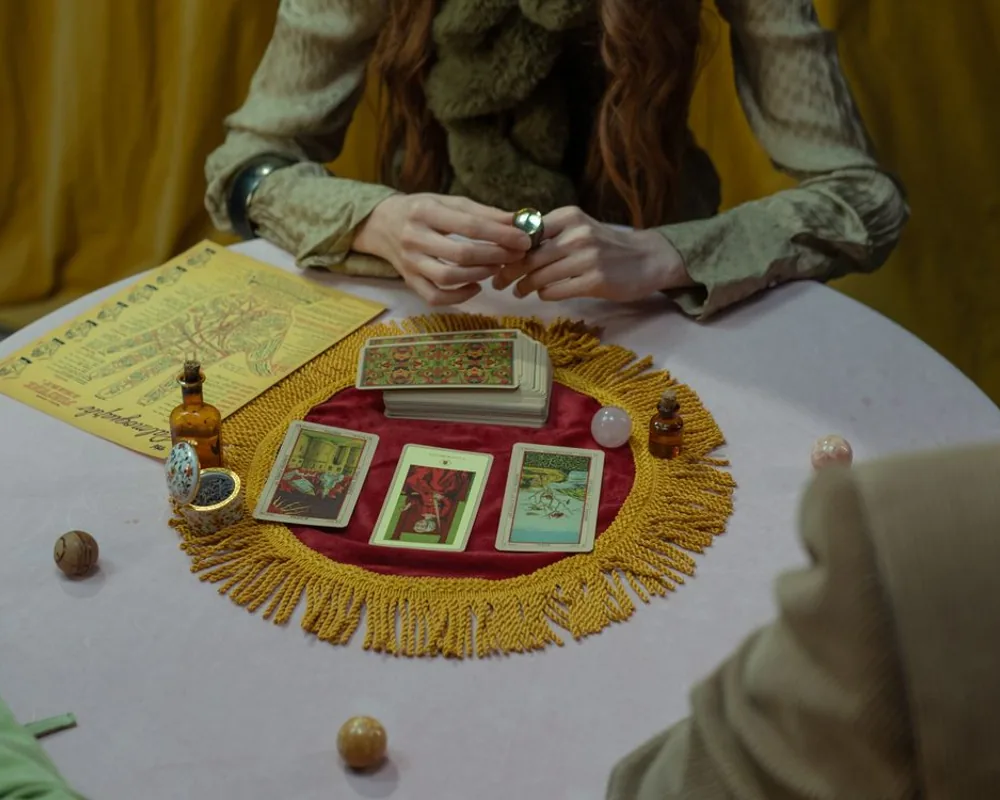
Three cards: a simple story
The basic Lifloris scheme: 'essence of the situation — what influences — advice.' It works better than the vague 'past — present — future' because the third position stays within the zone of action. For a temporal question use 'what shaped it — what is happening — where the current course leads' and call the outcome conditional.
Other precise triplets: 'what I want — what I fear — what I choose,' 'body — feeling — thought,' 'strength — risk — next step,' 'option A — option B — the decision criterion.' The criterion matters more than trying to make the cards choose for the person.
Read the triplet twice. First pass: each card in its position. Second pass: as a single sentence where the three cards become the subject, circumstance, and predicate of one story. If the sentence does not come together, look for the contradiction: that is the answer.
Positions matter more than quantity
A position is the question a specific card answers. 'Advice' and 'outcome' are different questions, and the same card answers them differently: the Nine of Wands as advice says 'hold your boundaries'; as outcome, 'the cycle will complete at a frontier you will have to defend.'
When designing your own scheme, test each position three ways: does its question differ from its neighbours? Can it be answered observably? Does it lead to action or understanding rather than a new portion of fog? If even one test fails, remove the position — the spread will only become clearer.
Common mistakes in short spreads
The first mistake is a spread without a question: 'just three cards.' Without a question, any interpretation is valid, which means none is verifiable. The second is duplicate positions: 'what he feels' and 'what he thinks about me' in one spread almost always merge into one mush.
The third is reading aloud without synthesis: three separate meanings instead of one story. The fourth is ignoring the inconvenient card: if one of the three 'does not fit,' it is most often the one carrying new knowledge. You already knew the other two.
Exercises
- 1Make seven one-card entries and at the end of the week mark which observations were accurate and which were forced.
- 2Read one triplet twice: first each card separately, then as a single sentence. Reduce the result to three clear phrases.
- 3Design your own triplet for a specific live question and test each position with the three tests from this chapter.
- 4Take an old spread and find the card you 'did not understand' back then. Re-read the spread starting from it.