Tarot crosses Europe
Games, regional rules, censorship, and mass printing
Key dates
Preachers, including Bernardino of Siena, denounce card playing as gambling, without mentioning magic.
The tarocchi game becomes established in France via Piedmont, Savoy, and papal Avignon.
Swiss, Besançon, and southern German printed Tarot variants take shape.
Revenue stamps on French and German packs document fiscal regulation of the card market.
Königrufen takes shape in German and Austrian lands and survives to the present day.
Not one deck, but a family of games
From northern Italy, Tarot games spread into France (through Piedmont, Savoy, and Avignon, then a papal territory), Switzerland, German- and Austrian-speaking lands, and Hungary. Rules changed with every transfer into a new gaming culture: some regions shortened the pack to 42 or 54 cards, some elaborated bidding and contract systems, and some replaced the old allegorical images with genre scenes of hunting, music, or daily life.
This variability is well documented in the decks themselves: comparing Swiss, Besançon, and Tyrolean printed Tarots of the seventeenth and eighteenth centuries shows differing iconography while preserving the shared 78-sheet structure (or local variants of it). French Tarot (Tarot à quatre and later Tarot à cinq), Austrian and southern German Königrufen, and Hungarian and Czech traditions are all still played today as parlor and club games, and for most players the historical narrative of the trumps is entirely irrelevant to actual play.
For historical accuracy it is worth stressing: well into the late eighteenth century, no known manual, treatise, or testimony describes Tarot being used for divination. This silence in the sources is not an archival accident but a consistent pattern across more than three centuries of printed and manuscript material about the game.
Bans, taxes, and moral panic
Card games, including Tarot, were regularly subject to church and secular bans as a form of gambling, not as an object of occult concern. Preachers of the era, such as the Italian reform friar Bernardino of Siena in the early fifteenth century, denounced cards alongside dice as a path to ruin and sin—but his invectives concern play and money, not magic.
Secular authorities more often taxed cards than banned them outright: playing cards made a convenient object of excise duty thanks to their standardized format and mass production, and the revenue stamps found on the wrappers of seventeenth- and eighteenth-century French and German packs are direct material evidence of state fiscal interest in the commodity.
Such regulation confirms Tarot's status as an ordinary, if somewhat costlier, commodity within the general playing-card market, embedded in the same economic and legal frameworks as everyday packs, rather than an exceptional object with a special sacred status.
Printing fixes the images
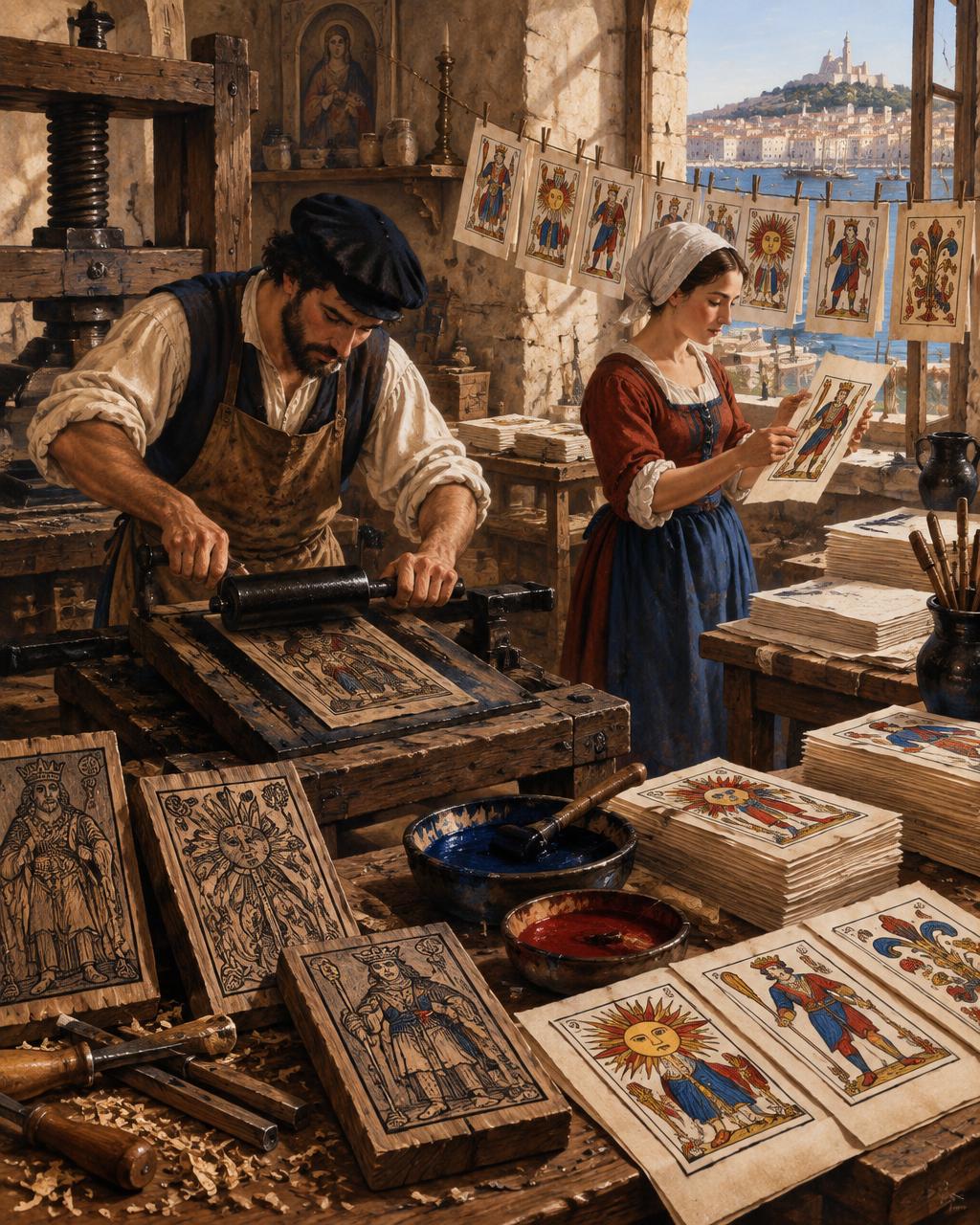
Woodblock printing and stencil coloring (the à la poncif technique, in which color was applied through cut-out stencils over a printed outline) turned unique court packs into workshop products. Production required several specializations—block carver, printer, and colorist—often combined within family businesses passed from father to son across generations.
Repeatable wooden blocks (punches) made the image sequence recognizable across large territories, but small details—gestures, attributes, background—kept shifting from city to city and carver to carver, since blocks wore out, were lost, and were recut from memory or from a neighboring workshop's example rather than copied from one single master template.
It was precisely this printed, reproducible nature of the deck—rather than the manuscript uniqueness of Visconti-Sforza—that prepared the ground for the next stage: the transformation of a regional workshop pattern into a loosely unified, easily recognizable visual language that would later be named Tarot de Marseille.