How cards influence one another
Adjacency, direction, amplification, and conflict
Adjacency and direction
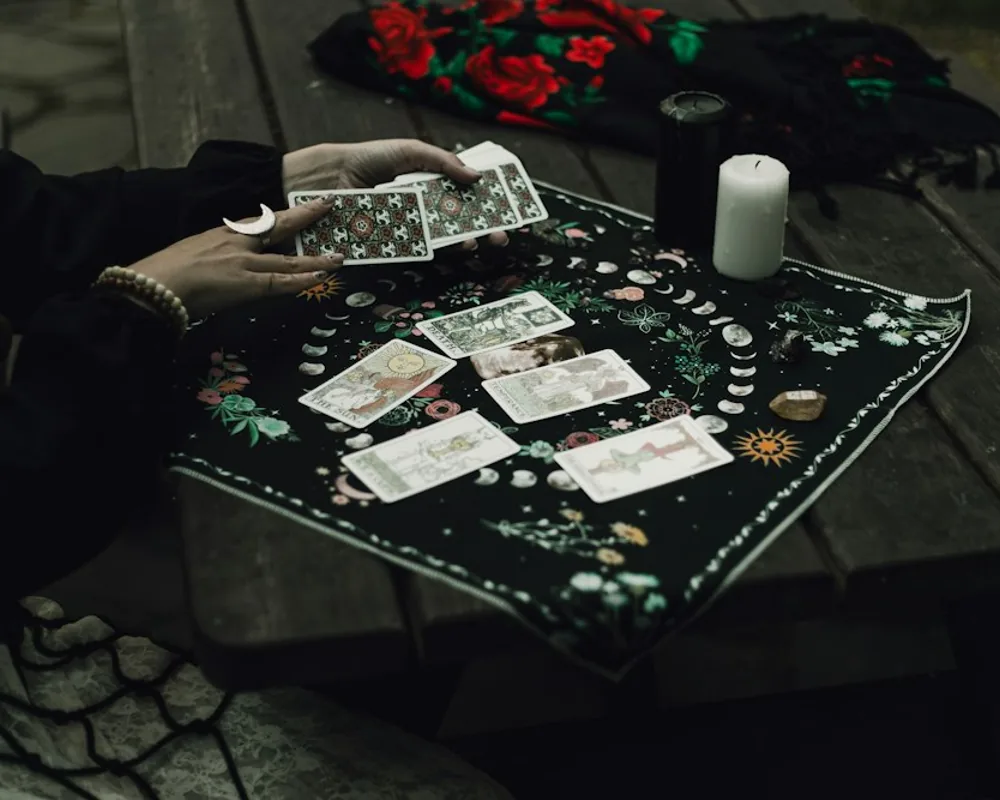
The card on the left usually reads as source or cause, the card on the right as development or result. If Justice stands to the left of The Tower, the collapse may be the consequence of an old imbalance; if The Star is to the right, recovery follows the crisis. The same Tower in the middle of these two stories is a different story.
The images support direction too: figures looking at each other create dialogue or confrontation; figures looking the same way create a shared vector; figures turned away mark a broken link between positions. This is not decoration but a hint at where energy flows in the spread and where it is blocked.
Amplification and conflict
Similar cards amplify the shared meaning: two water cards together deepen the emotional theme; two Majors about transformation say the change is inevitable and deep. A repeated number — two nines, for example — emphasises the stage of the process: the completion of a cycle is stated twice.
Opposite cards create conflict, doubt, or a change of direction. The Emperor next to The Fool is a clash of control and freedom; the Ten of Swords next to the Ace of Cups is the end of one story and the simultaneous birth of a feeling. Conflict is not a spread error but its nerve: this is where the question lives that the person dares not formulate.
A heavy card next to a supportive one is softened, but the warning remains. The Nine of Swords next to the Six of Wands does not cancel the anxiety; it says the anxiety coexists with real success and may be disproportionate to the facts. Softening does not mean crossing out.
Major Arcana as the axis
A Major next to a Minor sets the pair's main theme: the Minor shows how the large theme manifests in daily life. Death next to the Eight of Pentacles is transformation through daily work, a change of professional identity. The same Death next to the Two of Cups is a transformation of a relationship.
If there are many Majors in a spread — a third or more — the situation goes beyond the everyday: a stage, a role, a worldview is changing. Such a spread should not be reduced to advice like 'go to the interview.' Look for the inner transition the Majors describe, and only then translate it into practical steps.
Suits, numbers, elements in a group
Count the suits: a dominant suit amplifies its domain and shows through what the situation resolves. A money reading full of Swords says the question will be settled by analysis, contract, and a difficult conversation, not by arithmetic alone. A completely absent suit is also information: a feelings question without a single Cup is about feelings that are not being voiced.
Sequential numbers (five, six, seven) show development: the process moves step by step. A gap in the sequence — a three and suddenly a nine — reads as a leap or a delay: something between the start and the near-completion was skipped, and the spread hints at checking what exactly.
The spread as a whole
After reading the individual positions, step back. Count suits, Majors, court cards, repeated numbers, and the direction of figures. Find one main axis and one detail that resists it. The conclusion must explain both, not discard the inconvenient card.
Finish the synthesis in three parts: what is happening, what tension defines the situation, what observable step can be taken. If the conclusion cannot be linked to the person's actions, return to the question and positions — the reading has probably become too general.
Exercises
- 1Draw three cards and connect them with three different conjunctions: 'because,' 'but,' 'therefore.' Compare which logic best answers the question.
- 2Take one Major and two Minors. Formulate principle, manifestation, and action in one paragraph without listing dictionary meanings.
- 3Find a pair of cards with opposite meanings in a spread and write what unspoken question stands between them.
- 4Count suits and numbers in five old spreads from your journal. Note where the dominant suit matched the real course of events.