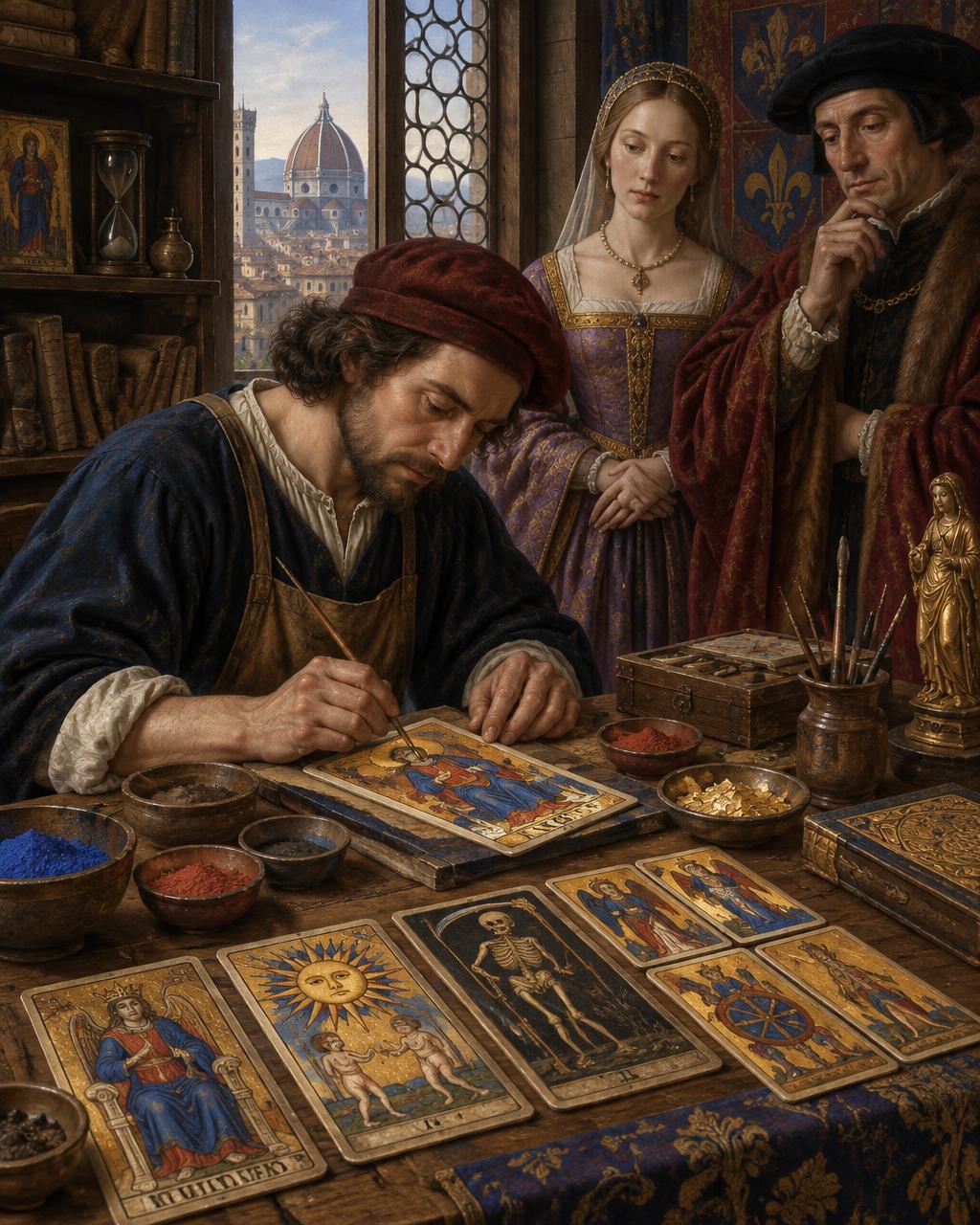
Before Tarot: the journey of playing cards
From East Asia and the Islamic world to Mamluk suits and the first European packs
Key dates
'Leaf cards' (yezi ge) are mentioned in China — a distant, documentarily unproven precursor of game sheets.
A four-suit pack with numeral and court cards takes shape in Mamluk Egypt and Syria.
Playing cards are documented in southern European cities.
A municipal ban in Florence is one of the earliest secure European references to card play.
Guilds of card makers form in Ulm, Nuremberg, and Augsburg; stencil-coloring spreads.
The earliest traces of playing cards
Game historians trace printed sheets with game-like imagery to Tang- and Song-era China, where paper and woodblock printing were developed long before Europe; candidates include the so-called 'leaf cards' (yezi ge) mentioned in ninth- and tenth-century sources. A documented, unbroken line from these sheets to later European packs has not been established — the connection remains a cautious reconstruction rather than a settled fact.
A more secure intermediate link is playing cards in the Islamic world, above all in the Mamluk Sultanate that ruled Egypt and Syria from the thirteenth to sixteenth century. A surviving fragment of a Mamluk pack (now in the Topkapı Sarayı collection in Istanbul, described by L. A. Mayer in 1939) already shows a familiar structure: four suits, numeral cards from ace to ten, and three court cards per suit. This find is a key reference point for historians, though it still does not answer the question of who invented cards first.
Trade and diplomatic contacts across the eastern Mediterranean—linking Venice, Genoa, and the Crown of Aragon—created many channels through which objects and practices could travel, rather than a single 'silk road for cards.' Modern game historians, above all Michael Dummett, therefore speak not of one act of borrowing but of a probable, if not minutely documented, diffusion through fourteenth-century ports and markets.
Cards arrive in Europe
In the second half of the fourteenth century, playing cards appeared rapidly in Mediterranean cities and beyond. The earliest securely dated reference is a 1377 municipal ban in Florence (condemning the card game 'naibbe' as gambling); cards are recorded almost simultaneously in Spain, Germany, and Switzerland. Such synchrony across a wide area suggests rapid spread of an already-known novelty rather than a single local invention.
Early European authorities alternately banned cards as gambling (municipal statutes in Florence, Paris, and Nuremberg) or taxed and regulated their production through guild charters — by 1400, guilds of 'card makers' (Kartenmacher) already existed in Ulm, Nuremberg, and Augsburg. Those records matter: they place cards in ordinary social life—taverns, courts, workshops, and markets. No fourteenth-century source describes them as a secret book or initiatory tool.
By the early fifteenth century, German-speaking lands saw the spread of stencil-coloring applied to woodblock prints, sharply cutting production costs and making cards accessible beyond the nobility. This is important background for Tarot: Tarot would emerge as an expensive courtly variation against the backdrop of an already-established mass culture of ordinary card play.
Suits change their language
Suits adapted to local culture: cups, coins, swords, and batons in the south (Italy, Spain) are, by the widely accepted hypothesis, derived from Mamluk-style suits (cups, coins, swords, and polo-sticks reinterpreted as batons). German-speaking lands developed a different set—hearts, bells, leaves, and acorns—while the French system (hearts, diamonds, spades, clubs), fixed by the mid-fifteenth century around Rouen and Paris, later became an international standard thanks to its suitability for simplified stencil printing.
Tarot would preserve the Italian suit system (cups, coins, swords, batons) while adding a radically new sequence of permanent trumps and an extra court card (the Knight) in each suit—fifty-six suit cards instead of the usual forty, plus a separate set of twenty-two allegorical sheets.
Regional suit differences persist in living card traditions today: Spanish and Italian systems, German and French ones are not variants of one template but parallel lines of development of a single game idea—a fact that itself warns against searching for one single 'original' and uniquely correct prototype of Tarot.